
Weight Loss and the Laws of Thermodynamics
If you are too busy to read to the end, here is a spoiler: I reject calories as a concept. No, I am not a calorie-denier, but calories have no place in human nutrition. They're a measure of heat energy and provide no information on the metabolic effect of foods on our physiology. Sure, if you eat less and move more, weight loss can happen. Good for you if it did. That doesn't mean it will happen for everyone, or that it's a reliable or sustainable approach.
Human metabolism isn't a furnace that burns food evenly. Hormones, sleep, stress, medications, and metabolic health all decide how the body uses or stores energy. Some people can eat less and lose weight for a while, but that success doesn't validate CICO (calories-in, calories-out). It just means their biology happened to cooperate under those conditions. For most people, hunger, fatigue, and metabolic slowdown eventually overrides progress.
People love to say "you can't break the laws of physics" when it comes to body weight. And they're right. The first law of thermodynamics still applies to humans. Shocker. I agree.
But the way it's used in the context of weight loss, oversimplified into "eat less, move more", has done more harm than good. It has turned a complex metabolic system into a moral equation and, in doing so, has led to confusion, frustration, guilt, and shame.
Let's go through what the law actually says, and why "CICO" is both technically true and practically meaningless.
The First Law of Thermodynamics states that energy cannot be created or destroyed. It can only change forms. In a closed system, energy in equals energy out plus the change in stored energy.
Applied to a human body, that means the energy we consume (food) must either be stored, used, or lost as heat or waste. On paper, that looks simple. In reality, we are not a closed system and we are not a combustion chamber.
By the way, when we lose weight, we do not use it as heat or waste, we exhale it as CO2 and water.
When scientists measure calories in a bomb calorimeter, they literally burn food in oxygen to measure the heat released. That's how the calorie values on food labels are determined. But humans don't set fire to food. We digest, absorb, convert, and regulate energy through countless biochemical pathways, hormonal feedback loops, and environmental signals.
Coal burns. But you cannot eat coal and gain weight. How about absorbing calories from sitting in the sun or in a sauna? Nope. Humans run on complex biochemical energy, not raw heat.
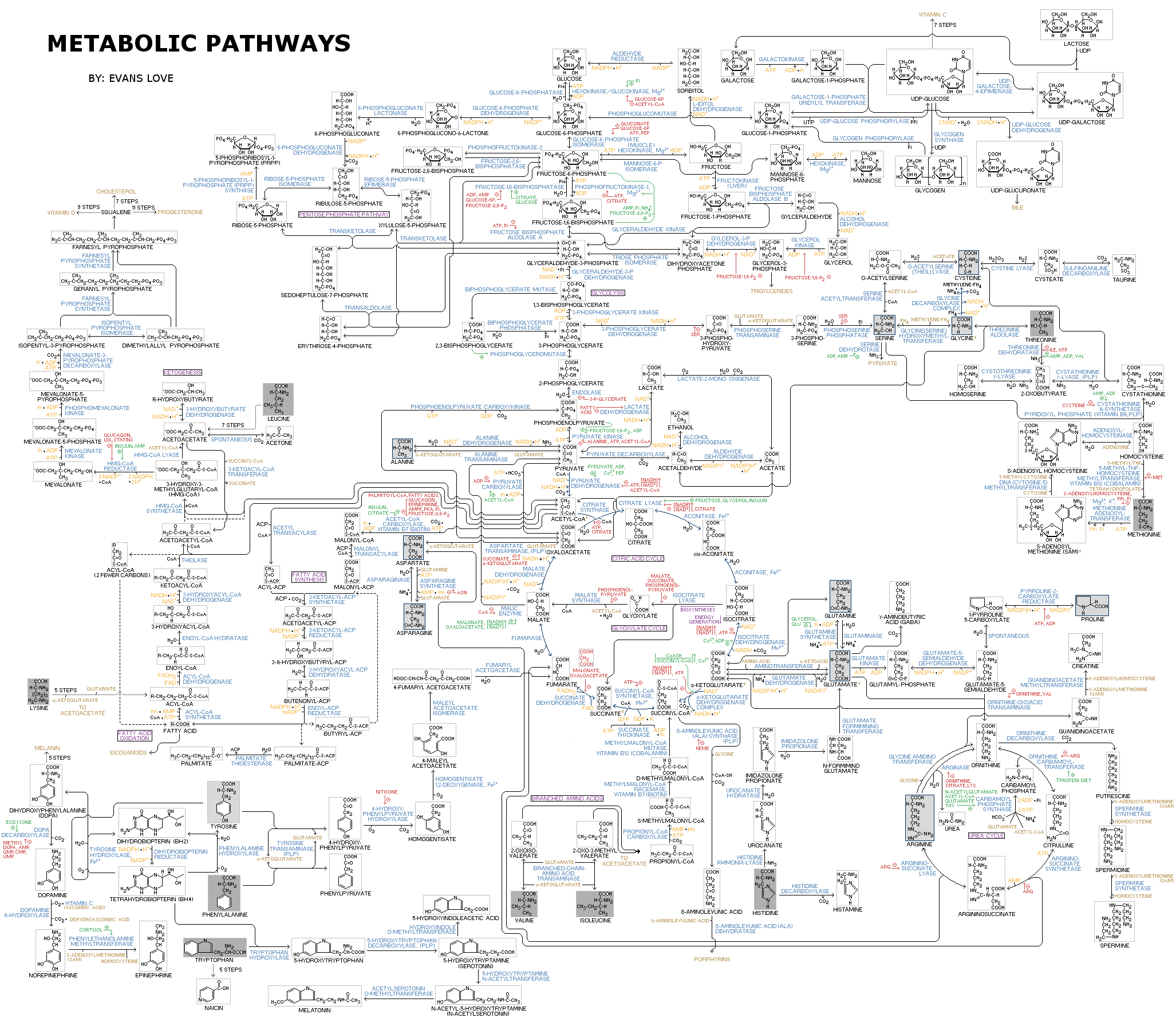
The first law of thermodynamics still holds. But it doesn't explain. To demonstrate, see this illustration of metabolic pathways. You will not find ‘calorie' written on a single enzyme or reaction step.
CICO - calories-in, calories-out - assumes that if you simply reduce calories in or increase calories out, fat loss will follow in a predictable, mathematical way. As much as CICO supporters want this to be true, it is just not that simple. The human body is geared to survival, and it will adapt.
When you eat less, the metabolic rate drops. The thyroid slows, leptin falls, ghrelin rises, cortisol may increase, and spontaneous movement decreases. The body adjusts to conserve energy.
On the other hand, when you eat more, especially in a metabolically healthy state, energy expenditure often rises. Thermogenesis, NEAT (non-exercise activity), and resting metabolism all increase to burn the surplus.
So while thermodynamics is not "broken," the human body constantly changes the variables. Variables that we cannot control. That's why the math rarely works as expected. A 500-calorie deficit doesn't guarantee one pound of fat loss per week, the same as a 500-calorie surplus does not result in a one pound per week weight gain.
"Calories in, calories out" has been repeated so often that it's now a moral statement. If someone gains weight, they're told they simply ate too much or moved too little, as if every change in body composition were a reflection of willpower.
This way of thinking has caused enormous harm. It has created fat shaming, guilt, and the belief that people with excess weight are lazy or out of control. It ignores the role of insulin resistance, disrupted sleep, medications, disease, and stress. It reduces human metabolism to personal failure.
People start to believe they just "don't have discipline." They restrict harder, then binge, then blame themselves. Decades of metabolic damage get dismissed as "non-compliance."
Worse, it gives rise to extreme restriction, yo-yo dieting, and a lifetime of disordered eating. People chase the "calorie deficit" like a moral badge, while their metabolic health deteriorates.
Also, it sends the wrong message as to what to eat. Fat, which has nine calories per gram, is avoided in favour of carbs, which only has four calories per gram. Again, this completely disregards the metabolic effect of fat and carbs.
And the saddest part is that the CICO message drives people away from solutions that actually work.
The human body obeys physics, but energy balance is a result, not an action step. You can't do "energy balance" any more than you can "do gravity."
What we call "energy balance" is the outcome of thousands of coordinated biochemical decisions, how much fat is oxidised, how much glucose is stored, how efficiently mitochondria work, how hormones regulate appetite and movement. Those aren't choices we make consciously. They're automated processes driven by metabolic signals, not willpower.
When those systems are healthy, energy balance happens naturally. When they're dysregulated, the body holds on to more than it needs. It suppresses fat oxidation, and amplifies hunger.
This process is called fuel partitioning. It decides whether energy is burned or stored. We can't track it, and we can't override it with willpower or math. All we can do is create the best conditions for metabolic health.
The body doesn't decide what to store or burn based on arithmetic. It decides based on hormonal signalling, primarily insulin.
If insulin is elevated, storage pathways dominate and fat breakdown is suppressed. If insulin is low, fat can be mobilised for energy.
This explains why two people eating the same number of calories can have completely different outcomes. One may burn fat while the other stores it. The difference is not explained by the first law of thermodynamics, it is explained by metabolism.
The math equation fails, because the body behaves more like a thermostat. Hormones set the "temperature," and the body sends thousands of chemical signals in real time to make micro-adjustments for maintaining homeostasis.
The Biggest Loser study puts one more nail in the CICO coffin. In 2016, researchers followed contestants from the TV show The Biggest Loser for six years after their extreme diet and exercise regimen. Despite losing massive amounts of weight, most regained it. And their resting metabolic rate dropped by an average of about 500 calories per day and stayed suppressed long after the show ended. Their bodies were burning fewer calories at rest than expected for their size, even many years later. That means the "calories out" side of the equation adapted downward, defending body weight as if starvation were ongoing. It's a physiological safeguard. The body fights to survive, not to look lean on television. No reunion shows, because we can't cheat biology.
Reference: Fothergill et al., Obesity 2016, DOI: 10.1002/oby.21538
Let's assume we could measure everything precisely.
Suppose you eat 2,000 calories a day. A 20% margin of error (which is well within the range of normal food label inaccuracy and reporting error) means you could be eating anywhere from 1,600 to 2,400 calories and not be aware of it. That's an 800-calorie swing per day. Over a week, that's 5,600 calories. Over a month, 22,000. Over a year, 264,000.
So that 20% margin of error could represent about 75 pounds of theoretical fat over a year.
No human can track that with precision. And that's just the "calories in" side. On the "calories out" side, your resting metabolism, thermic effect of food, and activity level fluctuate constantly based on hormones, sleep, temperature, stress, and food composition.
Even under the closest supervision, in a lab, where variables are supposedly controlled, CICO falls apart. In Kevin Hall's metabolic ward study, every meal was weighed, and every breath was measured inside a metabolic chamber. Yet when participants left the chamber, they appeared to burn about 500 more calories per day than the chamber predicted. Whether due to unmeasured movement or measurement limits, the result exposed how even elite research setups struggle to make "calories in, calories out" add up.
Hall published the data in The Lancet, while others, like Dr. Michael Eades, highlighted the contradictions in their analysis of what became known as the "Kevin Hall Effect."
Quantification of the effect of energy imbalance on bodyweight
Contradictions and Cognitive Dissonance: The (Kevin) Hall Effect
If a team of scientists in a sealed lab cannot perfectly track calories in and out, what chance does anyone have at home with food labels, apps, and guesstimates? We can't meaningfully measure either side of the equation, and the body is constantly changing the terms anyway. "Calories in, calories out" works on paper, not in living humans.
Undiagnosed Type 1 diabetics cannot gain weight, no matter how many "calories" they consume. I pointed this out as the ultimate proof that CICO is fundamentally flawed. In response they said "we are not talking about genetic abnormalities", "that is a paradox", "CICO."
Calling something a paradox or exception is a lazy attempt at explaining away why CICO fails.
My son was diagnosed with Type 1 diabetes just shy of his ninth birthday. He was ravenous and ate double of what everyone else ate. Still, he was starving. Upon diagnosis his doctor said my son was only days away from a coma. Did it mean he broke the laws of thermodynamics? Of course not. All this proves is that we cannot apply physics laws without also looking at metabolic processes.
Diabulimia describes Type 1 diabetics purposefully lowering their insulin dose to help them lose weight. Again, turning CICO on its head.
What does this mean for the average dieter? Weight loss is not about physics but biology. Sorry about that. Physics describes energy, but biology decides what the body does with it.
Gary Taubes has been one of the few voices to point out that thermodynamics describes what must happen, but not why it happens. It's not a predictive tool. Saying someone gained fat because they ate more calories than they burned is like saying a room got crowded because more people entered than left. True, but meaningless. The interesting question is why more people entered.
In metabolic terms, the question is why fat is being stored rather than used up. That "why" leads to insulin, hormones, food quality, macronutrient composition, and metabolic health, not just arithmetic.
Read: Why We Get Fat by Gary Taubes
We talk about thermodynamics not to prove that people "did it wrong," but to show that the old model falls short.
The goal is not to win a physics debate. It's to help people get healthy, free from shame, and back in control of their metabolism. The laws of nature still stand. But how the human body uses energy is far more intricate than "eat less, move more."
We cannot break thermodynamics. But we can stop misusing it.
I've lived both sides of the story: counting calories, and then counting carbs. Counting carbs fixed the root problems, and as a result, saved my life.
Eat like it matters,
–Coach Roxana
Written by Roxana Soetebeer, MPHC, NNP, MHP, PFC
Published October 11th, 2025
If you struggle with cravings, need help staying on track, or want accountability in your weight loss journey, I run weekly Zoom group sessions through Patreon.
These calls are a space to ask questions, get practical strategies, and learn how to reverse insulin resistance and diabetes with real food.
I also run a free Facebook community where you can connect and share your progress.
You are welcome to join us if you want support, connection, and tools that actually work.
Social Media:
Facebook
YouTube
X Roxana
X Joy
Coaching: Are you stuck on your weight loss journey? Check out our coaching programs. Book a free discovery call to find out if we are a good fit.
Patreon with weekly interactive Zooms.